Image Map
Showing posts with label Auditory Processing. Show all posts

Tuesday, September 16, 2014

S.A.L.L. for ALL: Fall [giveaway]

Did you see it? The latest thing to hit my store? I'm quite excited about it because I'm hoping it'll make planning much easier for fall. Perhaps another season might follow if people are interested!


It's 110+ pages FULL of fall themed material that is broken down by 4 themes: apples, pumpkins, leaves, and football. Did I mention it's CCSS aligned? There are activities that should work with K-5th grade students. Individual activities within each theme vary; however, in each theme there are nonfiction passages, 2 stories (one for K-2, one for 3rd-5th), and open-ended articulation activity, and a simple craft activity. 

The following CCSS are targeted in this packet:
K.L 1b. Use frequently occurring nouns and verbs
K.L 5c. Identify real life connections between words and their use
1.SL 6. Produce complete sentences when appropriate to task and situation
K.L 1f. Produce and expand complete sentences in shared language activities
1.RL 1. Ask and answer questions about key details in a text
1.L 4a. Use sentence-level context as a clue to the meaning of a word or phrase
K.SL 6. Speak audibly and express thoughts, feelings, and ideas clearly
2.L 4. Determine or clarify the meaning of unknown and multiple meaning words and phrases
K.L 5a. Sort common objects into categories to gain a sense of the concepts the categories represent
2.3.L 1b. Form and use frequently occurring irregular plural nouns
1.RL 9. Compare and contrast the adventure and experiences of characters of character in stories
K.L 1e. Use the most frequently occurring prepositions
3.L 5a. Distinguish the literal and nonliteral meanings of words and phrases 
K.L 5b. Demonstrate understanding of frequently occurring verbs and adjectives by relating them to their opposites
K.L 5d. Distinguish shades of meaning among verbs describing the same general action by acting out the meanings
2.3.L 1d. Form and use the past tense of frequently occurring irregular verbs

You can see all the different activities in the TpT listing and by downloading the preview. Here are a couple more pictures to give you more of an idea:

This is an idiom matching game, you can also choose to play without the answer choices:

These helmets are for comparing/contrasting:


These leaves are for irregular plurals:

Roll a die and cross off an antonym (synonym page also included):


You can win a copy by entering below:

Sunday, July 13, 2014

Take A Trip To The Speech & Language Zoo [giveaway]

I haven't posted about any new activities in quite awhile, but I'm super excited about this one! It's time to take a trip to the zoo, but this zoo is a little different than your typical zoo. First, you print out a zoo map (2 pages) for each student. Tell your student to circle the animals he/she will be visiting based on his/her goals. 


You can print the ticket page and give each student a ticket for answering correctly or print the whole page and have them color in a ticket each time they answer correctly:

Below is a description of what skill each animal targets:

-Giraffes: Articulation (pg. 7-11): Use with any articulation deck or app. Each card has a task. All cards are designed for word level, but can be altered for phrase/sentence level.

-Alligators: Synonyms & Antonyms (pg. 12-18): Some cards have a pair of words (decide if they are syn/ant) and some cards have one word and the student lists either a syn/ant.
-Elephants: Categories (pg. 19-23): Some cards have a category; students should name items that fit. Some cards have items; students should name the category.
-Flamingos: Idioms (pg. 24-28): Each card has an idiom in context; students discuss the meaning.
-Gorillas: Inferences (pg. 29-33): Each card features a short description and a question that requires inferring.
-Hippos: Similarities & Differences (pg. 34-38): Each card features 2 items; students state similarities and differences between them.
-Kangaroos: Attributes (pg. 39-43) Each card features an item; students name a set number of attributes.
-Koalas: Past Tense Verbs (pg. 44-50): Each card features a verb; students should make up a sentence using the past tense of the verb. Regular and irregular verbs are included.
-Lions: What Doesn’t Belong (pg. 51-55): Each card features 4 items; student should state what doesn’t belong and why.
-Monkeys: Main Idea (pg. 56-60): Each card features a short story; students should state the main idea.
-Pandas: Prepositions (pg. 61-64): Each card features a panda in various locations; students should state the preposition (4 each for on, in, under, above, between, in front, behind).
-Parrots: Plurals (pg. 65-68): Each card features a picture of items; student should state the plural form of the item. Includes regular and irregular plurals.
-Peacocks: Was/Were (pg. 69-74): Each card features a sentence; student should fill in was or were. Visual included to remind students when to use each form. 
-Penguins: Is/Are (pg. 75-80): Each card features a sentence; student should fill in is or are. Visual included to remind students when to use each form. 
-Walruses: WH Questions (pg. 81-85): : Each card features a WH question; student should answer the question.
-Turtles: Recalling Details (pg. 86-90): Each card features a sentence to read aloud and a question that requires the student to recall details. 
-Tigers: Analogies (pg. 86-90): Each card features an analogy; students should explain their answer.
-Rhinos: Create A Sentence (pg. 96-100): Each card features 2-3 words; students should create a sentence using all words on the card. 
-Snakes: Social Skills (pg. 101-105): Each card features a question that focuses on social skills. Student should role play or answer the question. Some are zoo related, others are not.
-Lizards: Nonfiction Passages (pg. 106-108): Each card contains information about a zoo animal. Use these to answer questions related to the information, summarize, or recall details. 
-Frogs: Problem Solving (pg. 109-113): Each card contains a situation with a problem; students should discuss how to solve the problem.
-Cheetahs: Asking Questions (pg. 114-118): Each card contains a prompt; students should ask an appropriate question.
-My Favorite Zoo Animal worksheet (pg. 119): Use this worksheet to have students write about their favorite animal. Look up facts or use some of the facts on the lizard cards.
-What Did You Do At the Zoo? Fill In Mini-Book (pg. 120-121): Use this mini-book to write about what animals you visited and why. Print the cover page (pg. 120) for each student and as many animal pages (pg. 121) as each student needs. Cut and staple the mini-book together. 


All the cards are the same size. I recommend printing, laminating, and putting each set on a ring for easy grab and go! Examples of cards:


There is a mini-book that your students can complete which will reinforce what they learned:


This is a HUGE 120 page packet. While the price tag may seem a bit steep, it's something that you can use year round and over multiple sessions, which will make planning much easier!

Click the picture below to be taken to the item:

I'm so excited about this product that I want to giveaway a copy to a lucky follower! 
Enter below:

Thursday, August 15, 2013

Daily Lang-Tic Tasks: 180 Tasks to Enhance Language and Articulation

This year in my speech room, I want to have a quick language and/or articulation task that students complete at the beginning or end of the session. Why? This should allow me time to quickly check over homework, while simultaneously fostering independence in my students and giving them more practice with their speech/language skills. 

I realize this might need tweaking throughout the year and won't always happen, but that's ok.

Introducing Daily Lang-Tic Tasks:
(click the picture to be taken to the TPT link)


The concept is simple. There are 180 pages that look like the picture below:
Red pictures frames have a language task, while blue picture frames have an articulation task. 


Display these somewhere in your room. You can print all pages and display one each day OR download and pull one on up on your iPad each day.

Language tasks include: comparing/contrasting, describing, unscrambling sentences, grammar, WH and how questions, inferences, prediction, categories, social skills, multiple meaning words, problem solving, and object functions.  

Articulation tasks require access to articulation decks. There are repeats of these tasks, only because it's difficult to come up with 180 different articulation tasks. The goal of these cards was to get more trials! There is a blank page included for your to add your own. 

I realize that for some students the task of the day might not exactly hit one of their goals/objectives. I tried to make the language tasks broad in nature and tasks that would generate language. You can have your students do the tasks out loud so you can hear them, write them down (language task), or maybe have them record themselves so you can listen later. 

What do you think? Is this something you'd utilize and how?

Tuesday, April 2, 2013

Earth Day Extravaganza: Speech Style!

If you've seen my Facebook page, you know I just finished posting an Earth Day packet (click on the picture to be taken to the TPT listing)!


This is what's included:
-open ended game board
-vocabulary poster
-Sprouting Categories cards
-"Heart Starts" Conversation Starter cards
-Pronoun Earth Kid cards (and visual)
-Fix Up the Earth Sentence cards
-Listening for Details Leaf cards
-Paper vs. Plastic sort
-Describing Tree cards (and visual)
-coloring page
-5 narrative writing pages

 See below for card examples:

Fix Up the Earth Sentences:


Listening for Details Leaves:


Visual for Describing Trees:


Sprouting Categories:


"Heart Start" Conversation Starters:


Pronoun Earth Kids:


Narrative writing pages:

To win a copy, enter below:

Sunday, March 31, 2013

Busy Weekend! Psst...freebie

Happy Easter, Passover, Spring Break to you all!

Decided to throw a freebie your way in the form of April Fool's Articulation (which is very similar to my 100th Day Articulation that people seemed to like). Click the picture below to be taken to the April Fool's activity and see an example below:


Some other new products in my store are: Multisyllabic Flowers and Mirror  - Summer Shades. Click on the title pages to be taken to the product! For Multisyllabic Flowers, I included some cards with pictures and some without, in an effort to get everyone what they needed:


Mirror - Summer Shades focusing on auditory memory and organization. Each pair of "shades" has 4 words that have to be rearranged to formulate a grammatically correct sentence. 


Hope you enjoy!


Friday, February 15, 2013

Listen Up! Take A Ticket!

I'm constantly trying to find fresh ways to target listening comprehension, since most of my students need practice with this skill. It can be one of the "less fun" areas for kids to work on. I found some cute ticket clipart from Ashley Hughes on TpT and decided to put it to good use.

Take A Ticket Listening Comprehension was born:


First, you get visual aids for reminders on 4 types of WH questions (who, what, where, when):


Print a copy of the "tickets." If you have a larger group, I'd suggest printing 2-3 copies of this page. Once cut/laminated, place the tickets in a container. 


Students listen to a story (there are 24 total) and take turns drawing a ticket. The ticket they draw will be the type of question they have to answer! For example, if the student draws a purple ticket, the SLP asks the "where" question. If the student answers correctly, he/she keeps the ticket. Whoever has the most tickets at the end wins!  

Each story is 4 sentences long and the questions/answers are right on the card:


Students will have to be listening carefully to each story. Then they will have to make sure they are answering the correct type of WH question. I hope you enjoy this listening comprehension activity with a twist!

Get it HERE!

Enter to win a copy below:

a Rafflecopter giveaway

Thursday, January 31, 2013

Can I Take Your Order?

I have several young students working on following directions and receptive language. With this age group, we also do A LOT of pretend play. I decided to create a restaurant/food themed receptive language activity that I dubbed "Can I Take Your Order?"


First, print a "tray" for each student:
Then cut and laminate the food item cards and place all face-up in the center of the table or room. You can print a copy of the food items for each student if you're just beginning to work on these skills or use only one set to make it more challenging. There are a total of 16 different food items. 

 The SLP can act as the "customer" and tell the students which 3 items to grab and put on their tray. I also put the pictures on the cards, so that younger non-readers can take turns being the customer. This can serve to work on expressive language or articulation!


Grab this game HERE

To win a copy, enter below:

Friday, January 25, 2013

Auditory Memory Tips

One of my favorite areas to work on is auditory processing skills. I find that a lot of kids (and adults) have difficulty with auditory memory. I often start by focusing on memory for numbers, words and sentences before moving on to paragraphs, etc. 

I like to teach compensatory strategies and then spend some time practicing them, while discussing with the students which strategies work better for them (some students do better with different strategies):

1. Rehearsal: I tell students to practice number/words/sentence under their breath or in their heads. 

1. Elaborative Rehearsal: This strategy works well for remembering words. We practice making up silly sentences with the words to help us remember them. For example, if the words are: flower, rock, pillow. I would say, "I put a flower and a rock under my pillow." 

3. Mnemonics: I teach this strategy using words also. For the above example, I would have the student write "F, R, P." Depending on the words, you could also rearrange the letters to make a word. For example, if the words are: hair, apple, toy = HAT.

4. Visualization: Telling students to "make a movie in your mind" sometimes helps them put meaning to a sentence or words. For example, the sentence might be "The girl with the blue shirt was running." I would tell the student to close his/her eyes and visual a girl with a blue shirt running. For words, I might  tell the student to visualize a table with all the items on top of the table. 

5. Chunking: This strategy works well with numbers. So if you are given: 4, 3, 5, 8 = tell the student to remember 43 and 58. 

When students become adept at using these strategies, I make it more difficult by throwing in an unrelated question before asking them to repeat the numbers, words, or sentence.

An example of this:
SLP: The words are banana, computer, and slide. 
Student: should be using a strategy of their choice to recall the words
SLP: What's your favorite color?
Student: Red.
SLP: Now what were those words I told you?

This shifts their attention and challenges their memory skills! 

Below are some handouts that might be helpful for parents/teachers to help explain auditory processing and auditory memory:

http://www.superduperinc.com/handouts/pdf/243_AuditoryProcessing.pdf
http://www.parent-childservices.com/handouts/classroom_management_capd_.htm
http://www.nathhan.com/audvishowto.htm
http://www.superduperinc.com/handouts/pdf/331_Auditory_Memory.pdf

How do you work on auditory processing/memory skills?

Saturday, January 5, 2013

Expressive Fiesta

Just finished a new expressive language activity using the same "fiesta" clipart as the Formulating Questions Fiesta! I call this new activity Expressive Fiesta and it targets older students. While it's labeled as an expressive activity, it can also be used to target WH questions, vocabulary skills, auditory comprehension and sequencing. 

First you need to cut out these 6 pictures and affix them each to a side of a die:

Then each student is given a worksheet like this:


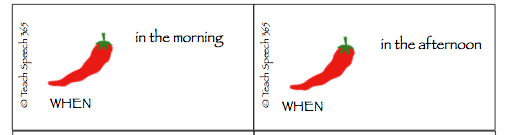
Students will roll the die and pick up a corresponding detail card. The cactus means you pick up a WHO card, the guitar means you pic up a WHAT card, the maracas means you pick up a WHERE card, the chili pepper means you pick up a WHEN card, and the sombrero means you pick up a WHY card. The student then fills in the details on the worksheet. Examples of the cards are below. WHO, WHAT, and WHERE cards  have pictures!


Once the details are all filled in, the student creates a story. He/she can write it out or verbalize the story. Other students might be asked to re-tell the story or asked questions about it. An example page is included in the activity:


Let me know what you think!  You can get this activity HERE!